Showing posts with label Latin Reader. Show all posts

Tuesday, January 24, 2017

Latin Reader (12): Arbor inest hortis Sophiae


OH MY GOSH: look what Sandy Brown Jensen has done with this! It's a beautiful story to go with the beautifully re-colored image: The Greenhouse: An Alchemical Fable. A must-read! :-)


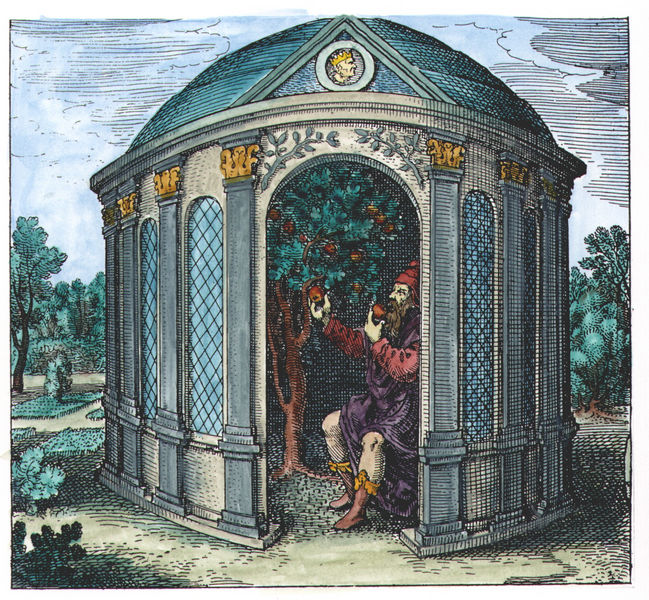
I already did Emblem VIII (about the egg), so today I can move on to Emblem IX from Michael Maier's Atalanta fugiens: Arbor inest hortis Sophiae. It features a famous mythological motif — golden apples — and the alchemical quest to extend human life (a very modern obsession also).

Arborem cum sene conclude in rorida domo et comedens de fructu eius fiet iuvenis.

Enclose a tree (arborem conclude) with an old man (cum sene) in a dewy house (in rorida domo) and by eating from its fruit (comedens de fructu eius), he will become young (fiet iuvenis).

For a hand-colored version, see Adam McLean's website: Emblem IX.


And here's the poem:

Arbor inest hortis Sophiae dans aurea mala,
Haec tibi cum nostro sit capienda sene;
Inque domo vitrea claudantur, roreque plena,
Et sine per multos haec duo juncta dies:
Tum fructu (mirum!) satiabitur arboris ille
Ut fiat juvenis qui fuit ante senex.

In the gardens of Wisdom (hortis Sophiae) there is a tree (arbor inest) bearing golden apples (dans aurea mala); you should take this tree (haec tibi sit capienda) together with our old man (cum nostro sene) and let them be enclosed (claudantur) in a house made of glass (inque domo vitrea) and full of dew (roreque plena). Allow these two to be together there (sine haec duo juncta) for many days (per multos dies); then — amazing! — (tum mirum!) that man will be fed (satiabitur ille) by the fruit of the tree (fructu arboris) so that he who was previously old (qui fuit ante senex) will become young (fiat iuvenis).

The commentary rejects the idea of literally regaining youth, while offering various allegorical interpretations, plus some funny observations, like this one:

Marsilio Ficino (Marsilius Ficinus) in his book about preserving the lives of scholars (in libro de studiosorum vita conservanda) writes that to attain long life (scribit ad aetatem longam attingendam) it is useful (utile esse) to suck the milk daily (ut quis lac exugat quotidie) from the breasts (ex uberibus) of a woman who is young and beautiful (cuiusdam feminae pulchae et iuvenis), while instead others praise (cuius vice alii laudant) eating the flesh of vipers (viperinam carnem comestam). But honestly (sed sane) these remedies are more taxing (haec media sunt rigidiora) than old age itself (ipsa senectute).

And now for your listening pleasure — a choral performance or just the musical fugue:


And the following is a list of the emblems I have completed so far:

Emblem I: Portavit eum ventus in ventre suo
Emblem II: Nutrius ejus terra est
Emblem III: Vade ad mulierem
Emblem IV: Conjunge fratrem cum sorore
Emblem V: Appone mulieri super mammas bufonem
Emblem VI: Seminate aurum vestrum
Emblem VII: Pullus a nido volans
Emblem VIII: Accipe ovum
Emblem IX: Arbor inest hortis Sophiae
Emblem XXXVI: Lapis projectus

Sunday, January 15, 2017

Latin Reader (11): Pullus a nido volans

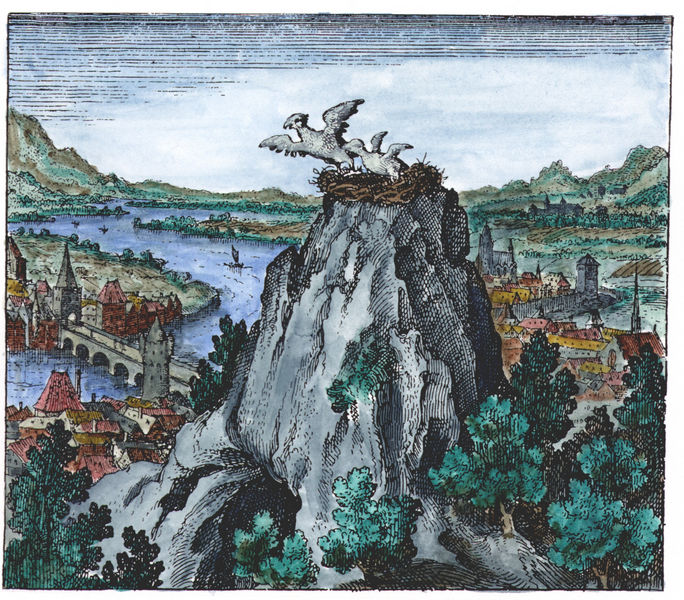
Today, it's Emblem VII from Michael Maier's Atalanta fugiens: Pullus a nido volans. Last time, we had an agricultural allegory, and now Maier turns to the world of nature for an allegory. The theme is the combination of contrary elements.

Pullus a nido volans, qui iterum cadit in nidum.

The chick flying from the nest, who again falls back into the nest.

For a hand-colored version, see Adam McLean's website: Emblem VII.


And here's the poem:

Rupe cava nidum Jovis ALES struxerat, in quo
Delituit, pullos enutriitque suos:
Horum unus levibus voluit se tollere pennis,
At fuit implumi fratre retentus ave.
Inde volans redit in nidum, quem liquerat, illis
Junge caput caudae, tum nec inanis eris.


Jupiter's bird (= eagle, Jovis ales) had built its nest (nidum struxerat) in a hollow rock (rupe cava); the eagle hid in the nest (in quo delituit) and nourished her chicks (pullos enutriitque suos). One of the chicks (horum unus) wanted to rise up (voluit se tollere) on his slight wings (levibus pennis), but he was held back (at fuit retentus) by his featherless brother bird (implumi fratre ave). The chick thus flies back (inde volans redit) into the nest which it had left (in nidum quem liquerat): join them head to tail (illis junge caput caudae) and then you will not be wasting your time (tum nec inanis eris).

Maier intends this as a lesson in the combination of contrary elements. The essay talks about the alchemical elements, and then turns again to the bird allegories from nature:
Hoc declaratur per duas Aquilas, pennatam et implumem, ex quibus illa volare conata ab hac retinetur. In Falconis et Ardeae pugna exemplum huius rei evidens est: ille enim celeri volatu et alis pernicibus superior in aere factus hanc unguibus prehendit et lacerat, cuius pondere in terram uterque decidit.
This is made clear (hoc declaratur) by the two Eagles (per duas Aquilas), one with feathers and one without (pennatam et implumem); when the feathered one of the two (ex quibus illa) tries to fly (volare conata) it is held back by the other (ab hac retinetur). In the fight between the falcon and the heron (in Falconis et Ardeae pugna) an example of this matter (exemplum huius rei) is evident (evidens est): for the falcon (ille enim) by his swift flight (celeri volatu) and agile wings (et alis pernicibus) rises higher in the air (superior in aere factus) and seizes the heron in its talons (hanc unguibus prehendit) and mangles her (et lacerat), but because of her weight (cuius pondere) they both fall to the ground (in terram uterque decidit). 
And now for your listening pleasure — a choral performance or just the musical fugue:


And the following is a list of the emblems I have completed so far:

Emblem I: Portavit eum ventus in ventre suo
Emblem II: Nutrius ejus terra est
Emblem III: Vade ad mulierem
Emblem IV: Conjunge fratrem cum sorore
Emblem V: Appone mulieri super mammas bufonem
Emblem VI: Seminate aurum vestrum
Emblem VII: Pullus a nido volans
Emblem VIII: Accipe ovum
Emblem XXXVI: Lapis projectus

Saturday, January 14, 2017

Latin Reader (10): Seminate aurum vestrum

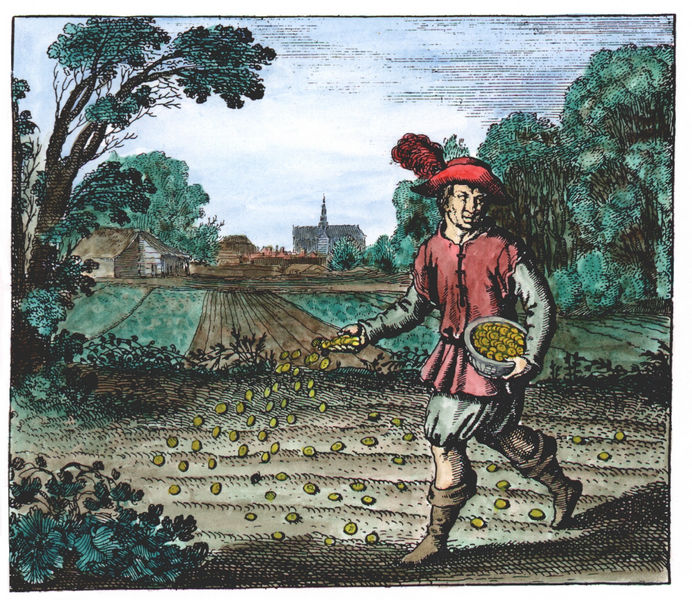
Today, it's Emblem VI from Michael Maier's Atalanta fugiens: Seminate aurum vestrum. Last time, I had skipped ahead to do the egg, so now I going back to where we left off.

Seminate aurum vestrum in terram albam foliatam.

Sow your gold into the white, leafy earth.

For a hand-colored version, see Adam McLean's website: Emblem VI.


And here's the poem:

Ruricolae pingui mandant sua semina terrae,
Cum fuerit rastris haec foliata suis.
Philosophi niveos aurum docuere per agros
Spargere, qui folii se levis instar habent:
Hoc ut agas, illud bene respice, namque quod aurum
Germinet, ex tritico videris, ut speculo.

Farmers send their seeds (ruricolae mandant sua semina) into the rich earth (pingui terrae) when it has been made leafy (cum fuerit haec foliata) by their rakes (rastris suis). Philosophers have taught us (philosophi docuere) to scatter gold (aurum spargere) through the snowy fields (niveos per agros) whose condition is (qui se habent) like a slender leaf (folii levis instar). In order to do it (hoc ut agas), consider this carefully (illud bene respice): for you will see (namque videris) that gold sprouts forth (quod quod aurum germinet) from the wheat (ex tritico).

Maier's commentary does not provide a lot of clues to the oddities of this little poem. Alchemy is like farming, but also not like it as we can see here: the philosophers sow, but they do so in the snows of winter. My guess is that the mirror means a reflection, but inverted: left is right, and right is left; spring is winter, and winter is spring. The really interesting part of the commentary to me is where Maier implies that all the agricultural gods of mythology are really just alchemical gods which the common people misunderstood, taking them literally instead of allegorically. I'm not sure what he means by the "Golden Gods," unless perhaps he is referring to the list of gods he just gave, so that Ceres, Triptolemus, Osiris, and Dionysus should not be thought of as agricultural gods (and a goddess, too: Ceres) but alchemical gods who reveal the secrets of gold, "Dei aurei."
So the ancients brought forth (hinc antiqui producerunt) Ceres, Triptolemus, Osiris, Dionysus, the golden Gods (Cererem, Triptolemum, Osiridem, Dionysum, Deos aureos) or those gods involved in chemistry (seu ad chemiam spectantes) as if teaching mortals (quasi docentes mortales) to cast the seeds of the fruits (semina frugum proiicere) into the earth (in terram suam), showing them (monstrantes) farming and viticulture (agriculturam et vitium propagationem) and the use of wine (vinique usum). All these things (quae omnia) the ignorant twisted (ignari detorserunt) to rural endeavors (ad rustica opera), but wrongly (at falso). For these are (sunt nam) the most arcane mysteries of nature (illa arcanissima naturae mysteria) which are hidden from the crowd (quae prae vulgo absconduntur) by these agricultural veilings (hisce agriculturae velamentis) and are made clear to the wise (et sapientibus declarantur).
And now for your listening pleasure — a choral performance or just the musical fugue:


And the following is a list of the emblems I have completed so far:

Emblem I: Portavit eum ventus in ventre suo
Emblem II: Nutrius ejus terra est
Emblem III: Vade ad mulierem
Emblem IV: Conjunge fratrem cum sorore
Emblem V: Appone mulieri super mammas bufonem
Emblem VI: Seminate aurum vestrum
Emblem VIII: Accipe ovum
Emblem XXXVI: Lapis projectus

Sunday, January 8, 2017

Latin Reader (9): Accipe ovum

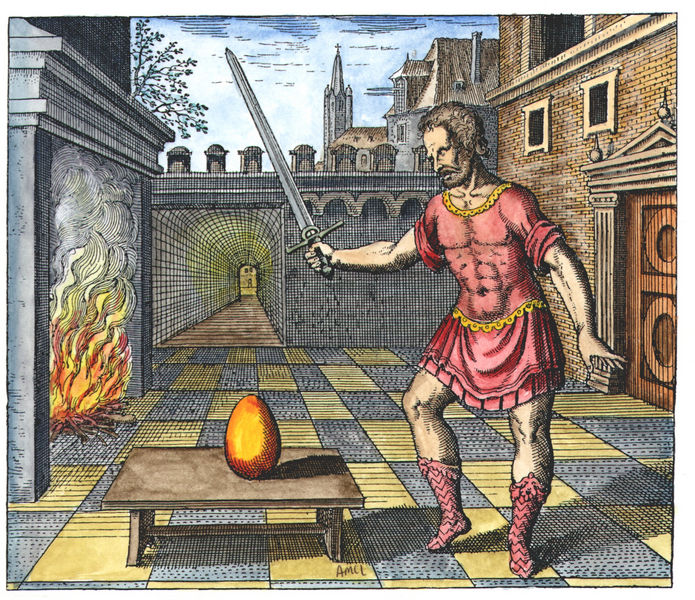
I'm skipping ahead to Emblem VIII in honor of Mia's mysterious egg, from Michael Maier's Atalanta fugiens: Accipe ovum et igneo percute gladio.

Which means: Take an egg (accipe ovum) and strike it (et percute) with a fiery sword (igneo gladio).

For a hand-colored version, see Adam McLean's website: Emblem VIII, and notice that he has chosen to make the egg a nice golden color!


And here's the poem:

Est avis in mundo sublimior omnibus, Ovum
Cujus ut inquiras, cura sit una tibi.
Albumen luteum circumdat molle vitellum,
Ignito (ceu mos) cautus id ense petas:
Vulcano Mars addat opem: pullaster et inde
Exortus, ferri victor et ignis erit.

In the world (in mundo) there is a bird (est avis) more sublime than them all (sublimior omnibus). Let your one concern be (cura sit una tibi) that you seek out its egg (Ovum cujus ut inquiras). A soft egg-white (albumen molle)
surrounds the golden-yellow yolk (luteum circumdat vitellum). Carefully you must strike it (cautus id petas) with a red-hot sword (ignito ense) as is the custom (ceu mos). Let Mars give strength to Vulcan (Vulcano Mars addat opem): and thus (et inde) a chick-like thing will arise (pullaster exortus erit), conqueror of iron and fire (ferri victor et ignis).

The discussion opens with the Roc (Ruc) who is able to carry elephants through the air (here's what that looks like), and Maier mentions several other species of real birds too, but admits that he has no idea exactly what type of bird is referred to in this poem.

The use of the word pullaster is really cool. You will not find the word in the Latin dictionary because it is a compound: pullus is the usual word for the young of some kind of animal, especially a chick (that's the origin of English "pullet"). The suffix -aster means something that is kind of like another thing, but not completely like it. The incompleteness of the resemblance often has a pejorative connotation. You see that in the English word "poetaster" for example: "a person who writes inferior poetry." People have also tried to use the words criticaster, philosophaster, and politicaster in English (among others), but none of those have caught on the way that poetaster has.

I wonder what would happen if Mia were to strike her egg with a red-hot sword of fire, using Mars and Vulcan to hatch the thing!

And now for your listening pleasure — a choral performance or just the musical fugue:


And the following is a list of the emblems I have completed so far:

Emblem I: Portavit eum ventus in ventre suo.
Emblem II: Nutrius ejus terra est.
Emblem III: Vade ad mulierem
Emblem IV: Conjunge fratrem cum sorore
Emblem V: Appone mulieri super mammas bufonem
Emblem VIII: Accipe ovum
Emblem XXXVI: Lapis projectus

Saturday, January 7, 2017

Latin Reader (8): Appone mulieri super mammas bufonem

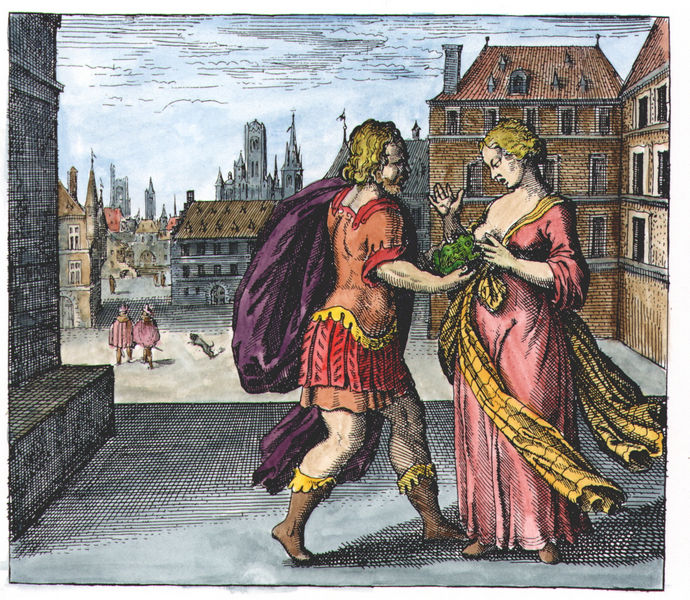
Today, it's Emblem V from Michael Maier's Atalanta fugiens: Appone mulieri super mammas bufonem. This emblem goes in a very weird direction, as you can see:

Appone mulieri super mammas bufonem, ut ablactet eum, et moriatur mulier, sitque bufo grossus de lacte.

Apply a toad (appone bufonem) to a woman's breasts (mulieri super mammas) so that she might nurse him (ut ablactet eum), and let the woman die (et moriatur mulier), and let the toad grow thick (sitque bufo grossus) with milk (de lacte).

For a hand-colored version, see Adam McLean's website: Emblem V.


And a detail of the toad:


Here's the poem:

Foemineo gelidus ponatur pectore Bufo,
Instar ut infantis lactea pocla bibat.
Crescat et in magnum vacuata per ubera tuber,
Et mulier vitam liquerit aegra suam.
Inde tibi facies medicamen nobile, virus
Quod fuget humano corde, levetque luem.

Let a cold Toad be placed (gelidus ponatur Bufo) upon a woman's chest (foemineo pectore), like a baby (instar infantis) so that it might drink (ut bibat) cups of milk (lactea pocla). And let it grow (crescat et) through the emptied teats (vacuata per ubera) into a great swelling (in magnum tuber), and the woman, sickened (et mulier aegra) will abandon her life (vitam liquerit suam). In that way (inde) you will make for yourself (tibi facies) a noble medicine (medicamen nobile) which can drive out poison (virus quod fuget) from the human heart ( humano corde) and can remove plague (levetque luem).

This is a gruesome business, and Maier even seems rather appalled himself, as he notes in the commentary:

Miserum hoc et horrendum spectaculum est, imo et impium, quod lac infanti destinatum bufoni, bestiae venenosae et naturae humanae adversanti praebendum sit.

This is a wretched spectacle (miserum hoc spectaculum est) and horrifying (et horrendum), even wicked (imo et impium) that milk for a baby (quod lac infanti destinatum) be offered to a toad (bufoni praebendum sit), a poisonous beast (bestiae venenosae) and hostile to human nature (et naturae humanae adversanti).

The death of the woman in the emblem reminds him of Cleopatra who placed serpents at her breasts (viperas mammis admovit) so that she would not be taken alive by her conquerors.

It turns out, though, that what this emblem is supposed to signify is the Toadstone, which you can read about at Wikipedia: Toadstone. Maier describes the Toadstone as a type of gold (hence the alchemical connection), a stone inside the Toad which exceeds the power of mineral gold:

[lapis], quem alii Boracem, Chelonitin, Batrachiten, Crapaudinam aut garatronium vocant. Hic enim auro longe praevalet virtute contra venena quaecumque animalium.

A stone (lapis) which others call (quem alii vocant), Borax, Chelonitis, Batrachitis, Crapaudine or garatronium. For this stone (hic enim) far exceeds gold (auro longe praevalet) in its power against any kind of animal poison (virtute contra venena quaecumque animalium).

So, this is the first bit of "animal medicine" that has made an appearance so far in Maier's book. I wonder if there will be more of this to come! I'm very interested in things like this, especially the Shamir. Given that the Shamir was connected by legend to King Solomon, perhaps it will make an appearance in the alchemical world too.

As for the toad sucking at the woman's breasts, this sounds more diabolical than alchemical, as the toad was one of the animals notorious as a familiar of witches.

And now for your listening pleasure — a choral performance or just the musical fugue:


And the following is a list of the emblems I have completed so far:

Emblem I: Portavit eum ventus in ventre suo.
Emblem II: Nutrius ejus terra est.
Emblem III: Vade ad mulierem
Emblem IV: Conjunge fratrem cum sorore
Emblem V: Appone mulieri super mammas bufonem
Emblem XXXVI: Lapis projectus

Wednesday, January 4, 2017

Latin Reader (7): Conjunge fratrem cum sorore

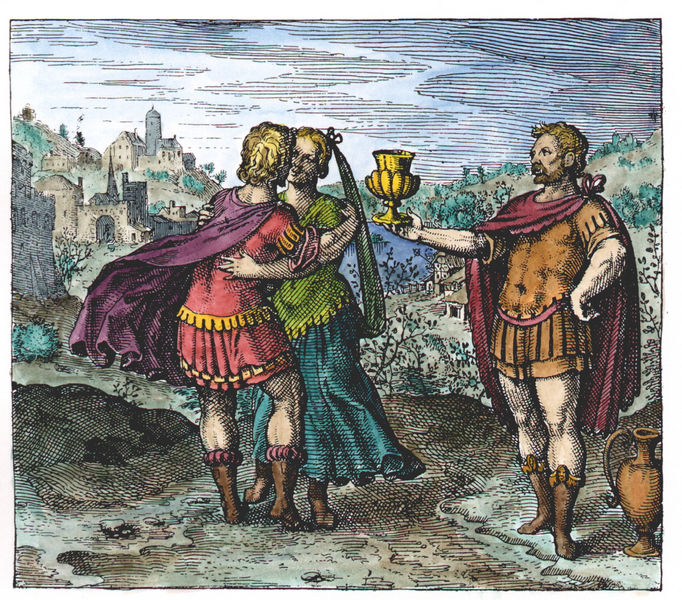
Today, it's Emblem IV from Michael Maier's Atalanta fugiens: Conjunge fratrem cum sorore. Last time, we had the alchemical laundress, and today we go back to the fertility themes of the Boreas-embryo and the Earth-nurse.

Conjunge fratrem cum sorore
et propina illis poculum amoris


Conjoin (conjunge) brother with sister (fratrem cum sorore) and drink to their health (et propina illis) the cup of love (poculum amoris)!

For a hand-colored version, see Adam McLean's website: Emblem IV.


And here's the poem:

Non hominum foret in mundo nunc tanta propago,
Si fratri conjunx non data prima soror.
Ergo lubens conjunge duos ab utroque parente
Progenitos, ut sint foemina masque toro.
Praebibe nectareo Philothesia pocla liquore
Utrisque, et foetus spem generabit amor.


There would not be (non foret) now in the world (in mundo nunc) such a great stock of people (hominum tanta propago), if the first sister (si prima soror) had not been given to her brother (fratri non data) as a spouse (conjunx). Therefore (ergo) gladly conjoin (lubens conjunge) the two offspring (duos progenitos) from both parents (ab utroque parente) so that there may be (ut sint) female and male (foemina masque) for the marriage bed (toro). Offer to them both (praebibe utrisque) the cups of Philothesia (Philothesia pocla) with the nectar liquor (nectareo liquore), and love will product (generabit amor) hope of pregnancy (foetus spem).

This word Philothesia is not a classical Latin word, nor is it a Greek word, but it appears to be a slightly mistransliterated version of the Greek ἡ φιλοτησία (κύλιξ), philotesia, the friendship or loving cup that was part of the Greek symposiastic ritual (the "h" probably crept into the -thesia to make it seem more Greek). See, for example, Thomas Elyot's 16th-century dictionary which defines Philothesia as "a solemne feaste amonge the Grekes."

The commentary explains that this refers not to "brother and sister" in the sense of family relations, but instead the male and female of the human species. What most struck me was the last paragraph of the commentary which is in praise of medical interventions, interpreting the "pocula" in medical terms, as fertility treatments:

Quis enim ignorat humanum genus Medicinae plurimum debere, propterea, quod multae hominum myriades, eius beneficio et opera, nunc in mundo extent, qui non fuissent, nisi eorum parentes aut proavia vitio sterilitatis per remotionem causae et sublationem, seu impedimenti proximi et remoti, vindicati et liberati, aut ab abortu matres praeservatae forent?

Who indeed does not know (quis enim ignorat) that humankind (humanum genus) owes much to Medicine (Medicinae plurimum debere), and thus that (propterea quod) many myriads of people (multae hominum myriades) now exist in the world (nunc in mundo extent) by virtue of Medicine's benefits and work (eius beneficio et opera) who would not exist (qui non fuissent) if their parents or grandparents (eorum parentes aut proavia) had not been emancipated and freed (nisi vindicati et liberati) from the defect of sterility (vitio sterilitatis) by the removal and elimination of the cause (per remotionem causae et sublationem) or of the blockage, near or far (seu impedimenti proximi et remoti), or if their mothers (aut matres) had not been kept safe (praeservatae forent) from miscarriage (ab abortu).

And now for your listening pleasure:


And the following is a list of the emblems I have completed so far:

Emblem I: Portavit eum ventus in ventre suo.
Emblem II: Nutrius ejus terra est.
Emblem III: Vade ad mulierem
Emblem IV: Conjunge fratrem cum sorore
Emblem XXXVI: Lapis projectus

Sunday, January 1, 2017

Latin Reader (6): Vade ad mulierem

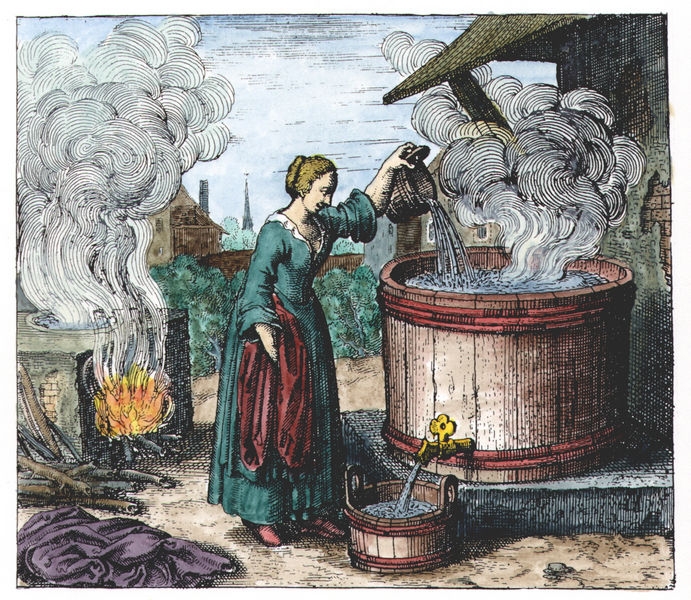
Today, it's Emblem III from Michael Maier's Atalanta fugiens: Vade ad mulierem. Yesterday, we had the Earth-as-Nurse, and today we have an ordinary woman doing ordinary laundry, but she is interpreted as a symbol of the alchemical craft:

Emblem III. Vade ad mulierem lavantem pannos, tu fac similiter.

Go do the woman who is washing clothes; do you the same.

Latin etymology: You can see in that Latin phrase "fac similiter" what will eventually become the English word "fax," i.e. fac simile, "make the same."

For a hand-colored version, see Adam McLean's website: Emblem III.


Abdita quisquis amas scrutari dogmata, ne sis
Deses, in exemplum, quod juvet, omne trahas:
Anne vides mulier maculis abstergere pannos
Ut soleat calidis, quas superaddit, aquis?
Hanc imitare, tua nec sic frustraberis arte,
Namque nigri faecem corporis unda lavat.

You whoever love (quisquis amas) to examine hidden doctrines (abdita scrutari dogmata), don't be idle (ne sis deses): you should extract (trahas) all that could be helpful (quod juvet omne) as an example (in exemplum). Don't you see (anne vides) how a woman is accustomed (mulier ut soleat) to cleanse garments of their stains (maculis abstergere pannos) by means of hot waters (calidis aquis) which she pours on them (quas superaddit)? Imitate her (hanc imitare): thus you will not be disappointed (nec sic frustraberis) in your technique (tua arte), for the wave washes (namque unda lavat) the residue of the black substance (nigri faecem corporis).

The commentary explains how this "alchemical" process starts with clothes that are dirty (earth) but the woman washes the clothes (water), and then hangs them to dry (air) in the sun (fire). This is the natural art of women alchemists: Haec est ars mulierum, quam ab ipsa natura didicerunt, "This is the women's art which they learned from nature herself."

Next time I do laundry, I will be thinking alchemical thoughts! :-)

Finally, for your listening pleasure:


I'm not sure why Burt Griswold's recording of this particular fugue is not set up for embedding, but you can listen to it at YouTube.

And the following is a list of the emblems I have completed so far:

Emblem I: Portavit eum ventus in ventre suo.
Emblem II: Nutrius ejus terra est.
Emblem III: Vade ad mulierem
Emblem XXXVI: Lapis projectus

Saturday, December 31, 2016

Latin Reader (5): Nutrix ejus terra est.

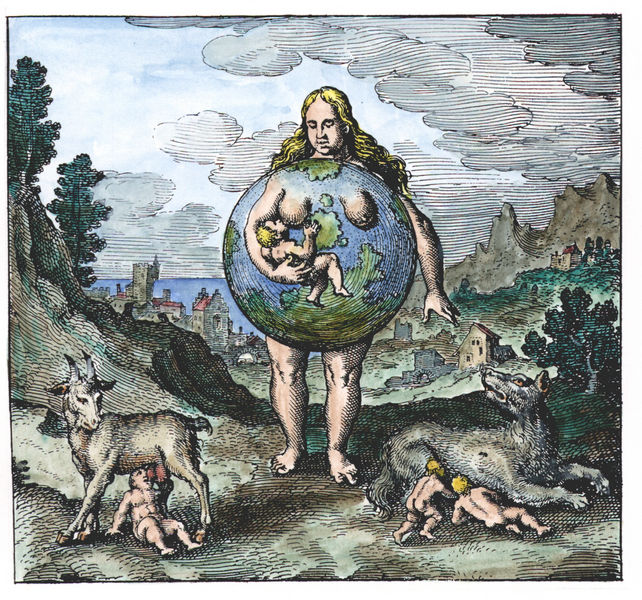
Today, it's Emblem II from Michael Maier's Atalanta fugiens: Nutrix ejus terra est. Yesterday, we had an embryo in the belly of the Mercury-Wind, and today we have a little baby being suckled by the Earth. This one is more mythology than alchemy, as you can see the Earth here with the goat-nurse of Zeus on the left and the wolf-nurse of Romulus and Remus on the right. For a hand-colored version, see Adam McLean's website: Emblem II.


I think the wolf is the most nicely drawn of the three:


Here is the Latin text:

Nutrix ejus terra est.

His nurse (nutrix ejus) is the earth (terra est).

Note that this is nurse not in the sense of doctor-and-nurse but in the sense of a nurse-maid, someone who nourishes (nutrix/nutrition) a baby.

Romulus hirta lupae pressisse, sed ubera caprae
Jupiter, & factis, fertur adesse fides:
Quid mirum, tenerae SAPIENTUM viscera PROLIS
Si ferimus TERRAM lacte nutrisse suo?
Parvula si tantos Heroas bestia pavit,
QUANTUS, cui NUTRIX TERREUS ORBIS, erit?

[I have taken it upon myself to correct "tantas Heroas" to "tantos Heroas" so that the noun and adjective agree; Heroas is a Greek form, but masculine in gender.]

Romulus is said to have squeezed (Romulus pressisse fertur) the shaggy teats of a she-wolf (hirta lupae ubera) but Jupiter those of a nanny-goat (sed caprae Jupiter), and faith is said to have been put in those events (et factis adesse fides). What's odd then (quid mirum) if we report (si ferimus) that the EARTH nourished with her milk (TERRAM lacte nutrisse suo) the flesh of the tender OFFSPRING (tenerae viscera PROLIS) of the WISE MEN (SAPIENTUM)? If so small a beast (parvula si bestia) fed such great Heroes (tantos Heroas pavit), HOW GREAT will be he (QUANTUS erit) whose NURSE (cui NUTRIX) is the EARTHLY ORB (TERREUS ORBIS)?

You can read about Romulus and his twin Remus and the wolf who suckled them at Wikipedia: Capitoline Wolf.

The goat who suckled Jupiter also has an article at Wikipedia: Amalthea. She is the origin of the famous aegis and also of the constellation Capra (but not Capricorn; that is a differently mythological creature). Amalthea's horn is the proverbial "cornucopia," the horn (cornu) of plenty (copia, as in the English word copious).

Finally, I am so struck by the depiction of the mythological Earth-Nurse here because it reminds me of the depiction of Bhu-Devi, the Earth-Goddess, mother of Sita, in Nina Paley's brilliant film "Sita Sings the Blues." The opening of the film shows a great cosmic dance where you can see Paley's version of Bhu-Devi at about 4:45 into the opening sequence:


And you can see Nina Paley's Bhu-Devi in this poster: the colossal size here definitely matches the sense of scale that Michael Maier wants to convey in his Atalanta fugiens emblem:


And for your listening pleasure, here are performances —one with chorus, one without — of Maier's fugue for this emblem:


And here is a list of the emblems I have completed so far:

Emblem I: Portavit eum ventus in ventre suo.
Emblem II: Nutrius ejus terra est.
Emblem XXXVI: Lapis projectus

Friday, December 30, 2016

Latin Reader (4): Ventosa alvus

Now that I can get musical accompaniment for the "fugues" that accompany each emblem in the Atalanta fugiens,  I am really going to enjoy doing these posts! I did Emblem XXXVI because it had showed up in Roos, and now I'll go back to the beginning and start with the first emblem: Portavit eum ventus in ventre suo.

Portavit eum ventus in ventre suo.
The wind carried him (portavi eum ventus) in his stomach (in ventre suo).

Note the nice wordplay on ventus (wind, like in our word ventilate) and venter (stomach, like in our word ventriloquist).

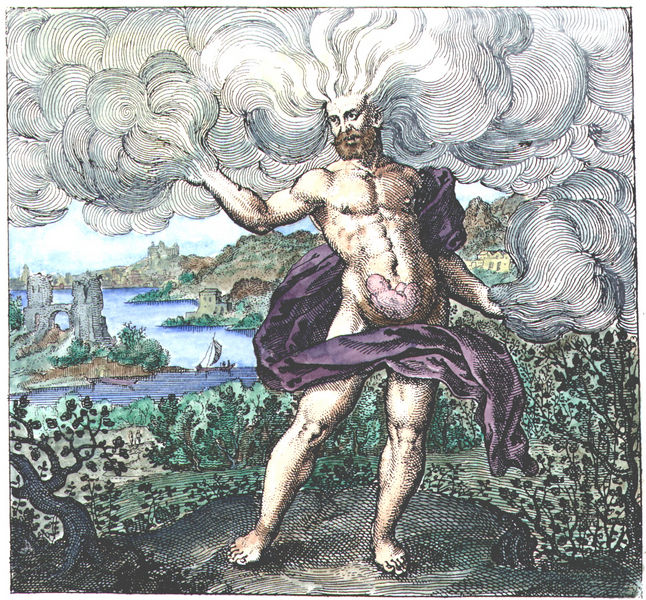
Here is the image: look for the baby in the belly! For a hand-colored version, see Adam McLean's website: Emblem I.


Here's the baby:


Embryo ventosa Boreae qui clauditur alvo, 
   Vivus in hanc lucem si semel ortus erit;
Unus is Heroum cunctos superare labores
   Arte, manu, forti corpore, mente, potest.
Ne tibi sit Caeso, nec abortus inutilis ille, 
   Non Agrippa, bono sydere sed genitus.

For the first 10 emblems, there is a transcription by Clay Holden of British Library MS. Sloane 3645 (although sad to say, the British Library has not made a digitized version available online):

If BOREAS can in his own Wind conceive
An offspring that can bear this light & live;
In art, Strength, Body, Mind He shall excell
All wonders men of Ancient Heroes tell.
Think him no Caeso nor Abortive brood,
Nor yet Agrippa, for his Star is good.

Here is a more literal translation:

If the embryo of the North Wind (si embryo Boreae), who is enclosed (qui clauditur) in his windy womb (ventosa alvo), should but once (semel) arise (ortus erit) living (vivus) into this light (in hanc lucem), he alone (is unus) can exceed (potest superare) with his skill, fighting hand, strong body, and mind (arte, manu, forti corpore, mente) all the labors of the Heroes (Heroum cunctos labores). Don't you suppose (ne tibi sit) that he is born by Caesarian section (ille Caeso) nor that he is a useless abortion (nec abortus inutilis), nor a breech birth (non Agrippa), but born (sed genitus) with a good star (bono sydere).

The image recalls Zeus bearing his infant son Dionysus in his own body (in his thigh, to be precise) after having incinerated Dionysus's mother Semele. I was even thinking the somewhat odd "semel" in the poem might be an allusion to her name. In the commentary that goes with the poem, there is mention both of the Semele story and also the story of the birth of Asclepius, son of Apollo, whom Apollo rescued from his mother's womb while she burned on the funeral pyre.

Mercurius itaque est ventus, qui sulfur seu Dionysium, aut, si mavis, Aesculpaium adhuc imperfectum foetum ex ventre materno, vel etiam ex cineribus corporis materni combusti accipiat, et portet eo, ubi maturari possit.

Thus Mercury (Mercurius itaque) is the wind (est ventus), who would take to himself (qui accipiat) sulfur or Dionysius (sulfur seu Dionysium) — or, if you prefer (aut, si mavis), Asclepius (Aesculpaium) — while still an unformed foetus (adhuc imperfectum foetum) from the maternal stomach (ex ventre materno) or even from the ashes (vel etiam ex cineribus) of the maternal body (corporis materni) that had been burnt (combusti), and would then carry him (et portet) until (eo ubi) he could mature (maturari possit).

And now, here is the recording:


Or just the music if you prefer; you can get a CD of this arrangement by Burt Griswold at his website, AgonMusic.com.


Thursday, December 29, 2016

Latin Reader (3): De secretis Naturae.

Here is an item for the Alchemical Latin Reader from Atalanta fugiens which is online at Hathi Trust and also at Dresden; the Dresden copy is the source I used for the image below. I chose this one because it shows up in Roos; see the Roos post (and comments!) for more context. There's also a Wikipedia article about this fascinating book.

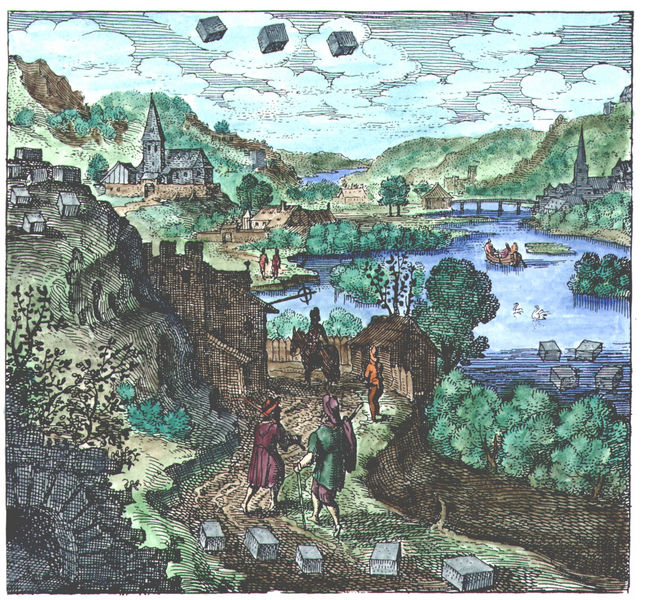
Here is a full-sized view of the image. For a hand-colored version, see Adam McLean's website: Emblem XXXVI.


If you look closely, the alchemical symbol for Mercury is hidden in the picture.


XXXVI. De secretis Naturae.

36. Concerning Nature's secrets

Lapis projectus est in terras, et in montibus exaltatus, et in aere habitat, et in flumine pascitur, id est, Mercurius.

The stone (Lapis) has been cast (projectus est) onto the lands (in terras), and it has been lifted up (et exaltatus) in the mountains (in montibus), and it abides (et habitat) in the air (in aere), and it feeds (et pascitur) in the stream (in flumine), i.e. (id est) Mercury (Mercurius).
Vile recrementum fertur Lapis atque jacere
Forte viis, sibi ut hinc dives inopsque parent.
Montibus in summis alii statuere, per auras
Aeris, at pasci per fluvios alii.
Omnia vera suo sunt sensu, postulo sed te
Munera montanis quaerere tanta locis.

And the stone (atque Lapis), vile refuse (vile recrementum), is said to lie (fertur jacere) by chance (forte) along the ways (viis), so that thus (ut hinc) rich and poor (dives inopsque) come across it (sibi parent). Others have stated (alii statuere) that on the highest mountains (montibus in summis), by the breezes of air (per auras aeris) it is fed (pasci), but others (at alii) that is is fed by the rivers (per fluvios). All these things (omnia) are true (vera sunt) in their own meaning (suo sensu), but I advise you (postulo sed te) to seek (quaerere) such great gifts (munera tanta) in the mountain places (montanis locis).

There is also a musical rendering, and I even found audio recordings at YouTube! Here is what the Wikipedia article says about the pieces of music that accompany each epigram: "An epigram in verse set to music in the form of a fugue for three voices - Atalanta, or the vox fugiens; Hippomenes, or the vox sequens, and Pomum objectum (Apple) or vox morans. "Atalanta fugiens" is a play on the word fugue."


This one has a vocal performance:


There is some good stuff in the discussion that accompanies the epigram also, invoking the story of Medea as a prophetess and illustrating how a lump of earth can possess arcane powers:

Quid gleba terrae communius? Attamen Euripylus Neptuni filius eam Heroibus Argonautis pro xenio obtulit, ex qua non recusata, sed grato animo accepta, post dissoluta in aqua Medea multa vaticinata est.

What is more common (Quid  communius) than a lump of earth (gleba terrae)? Yet Eurypylus (Attamen Euripylus), the son of Neptune (Neptuni filius), offered it (eam obtulit) to the Argonaut heroes (Heroibus Argonautis) as a gift (pro xenio). It was not rejected (non recusata) but accepted (sed accepta) in a grateful spirit (grato animo), and then (post ) from it (ex qua), dissolved in water (dissoluta in aqua), Medea (Medea ) made many prophecies (multa vaticinata est).


Tuesday, December 27, 2016

Latin Reader (2): Astutam vulpem gallus voret

Here is an item for the Alchemical Latin Reader from Stoltzius's Viridarium chymicum of 1624 (PDF download); I chose this one because of the fox. This fox is both devouring a rooster (as you would expect) and being devoured in turn (paradoxically). The poem explains:

Tertia Clavis Basilii (Basil's Third Key)


E petris aquilae rigidum conjunge Draconem: 
Exuret pennas, solvet et ille nives. 
Cum sale coelesti sulphur servare memento, 
Astutam vulpem gallus ut inde voret. 
Ales mersus aquis ad vitam ex igne redibit, 
Sentiet atque parem vulpis ab ore necem.

Out of the eagle's stones (e petris aquilae), join the stiff Dragon (rigidum conjunge Draconem): He will burn the feathers (exuret pennas), and he will also melt the snows (solvet et ille nives). Remember to keep the sulphur (sulphur servare memento) with the heavenly salt (cum sale coelesti) in order that (ut inde) the rooster devour the sly fox (astutam vulpem gallus voret). The winged one (ales), dipped in the waters (mersus aquis), will return to life (ad vitam redibit) out of the fire (ex igne), and he will feel (sentiet atque) a corresponding murder (parem necem) by the mouth of the fox (vulpis ab ore).

Here's a close-up that shows the fox, and also shows how there is the alchemical symbol for iron coming out of the dragon's mouth:


For some clues to the symbolism, see this article: A fresh look at alchemy by Lawrence Principe (cached at Google). Under the heading "The golden key," Principe discusses the twelve emblems of Basilius Valentinus, which is what we find in the first section of Stolzius also: "If you can interpret it, the third key of Basilius Valentinus encodes the volatilization of gold chloride." You can see the similarity in the emblem that Principe includes, although the directions are rather different and more detailed, and Principe deciphers the symbolic language in order to describe how it might produce gold chloride. See the article (cached at Google) for details.


You can also read an English rendering of the Third Key here: The Hermetic Museum by E. A. Waite — here is what it says about the fox and the rooster: "then the Cock will swallow the Fox, and, having been drowned in the water, and quickened by the fire, will in its turn be swallowed by the Fox."

Monday, December 26, 2016

Latin Reader: Virtus Unita Fortior
Okay, I had really sworn off new Latin projects a few years ago (after my school turned down every request I made to teach Latin over a ten-year period... yes, even I can learn, eventually, to stop banging my head against the wall, ha ha). But now, with this new alchemy project, I don't think I can resist: this combination of image and text is irresistible. So, slowly but surely, I am going to start piecing together a Latin Alchemical Reader, focusing on the words that appears in emblematic images along with the Latin texts that might accompany the image. Of all my hobbies, Latin is apparently the one I cannot give up no matter how hard I try!

So, for the first item in the Alchemical Latin Reader, I want to use the image that I found in this book by Baro Urbigerus. The book is in English, but the emblematic frontispiece is in Latin. The book's title pretty much says it all: Aphorismi Urbigerani, or, Certain rules clearly demonstrating the three infallible ways of preparing the grand elixir, or circulatum majus of the philosophers : discovering the secret of secrets, and detecting the errors of vulgar chymists in their operations : contain'd in one hundred and one aphorisms : to which are added, The three ways of preparing the vegetable elixir, or circulatum minus / all deduc'd from never-erring experience by Baro Urbigerus. It's online at Hathi Trust.

The title page describes Baro Urbigerus as "a servant of God in the Kingdom of Nature," but who was this fellow exactly? It's not clear at all. The CERL Thesaurus says only "Pseudonym e. unbekannten Alchimisten, vermutl. aus England." So, our Baron Urbiger gives us a mystery to begin with. I wonder if we will ever know who he was!

Here is the emblematic frontispiece; I will translate the Latin bits one by one:


Virtus unita Fortior. Vigor (virtus) united (unita) is stronger (fortior). 


Nil sine vobis. Nothing (nil) without (sine) you (vobis). The "you" is plural. 


Per Nos omnia. Through (per) us (nos) everything (omnia). 


Pulchritudine tua captus sum. By your beauty (pulchritudine tua) I am captured (captus sum). The speaker is masculine (Apollo paired with Diana), as indicated by masculine captus.

Ulterius te vinciam. Further (ulterius) I will bind / would bind (vinciam) you (te). 


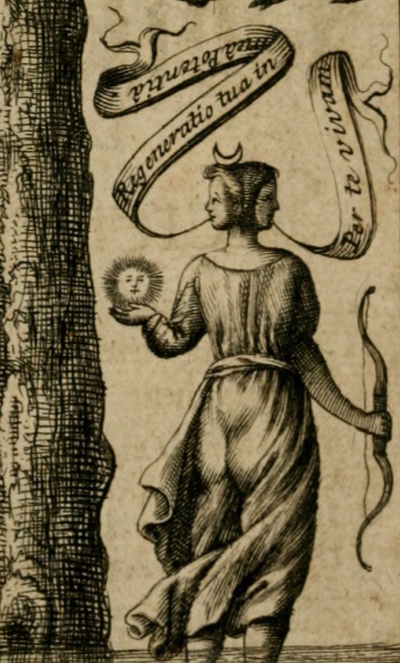
Regeneratio tua in mea Potentia. Your regeneration (regeneratio tua) is in my power (in mea Potentia).
Per te vivam. Through you (per te) I will live / would live (vivam). 


The book contains a "postscript" which is a commentary on the emblematic image: you can see what you think of the interpretation provided!

~ ~ ~

Having in our One Hundred and One Aphorisms so perspicuously laid open all the Difficulties, and so amply taught the compleat Theory and Practice of the whole Hermetic Mystery, that any ingenious Lover of Chymistry will not only be enabled to understand the most abstruse writings of the Philosophers, but also to effect any real Experiment, which is to be expected in the Progress of our Celestial Art; and yet being apt to believe, that such, as are not our Disciples, may perhaps meet with some of the Philosophical Figures, the meaning of which they may not so easily comprehend, we have judg'd it highly experient, in the Front of this our little Book to place this our Figure, by which, being a perfect Compendium of all the Philosophical Emblems, the rest maybe without any great difficulty understood. Now since this our Figure, mystically representing all our subjects and Operations, cannot but admit of many and various Interpretations, all which if we should here set down, our Aphorisms (where they are already delivered, and of which this would then be a Repetition,) would be altogether useless and insignificant: we therefore at first esteemed it very superfluous to give any farther Illustration of it. But our desire being to do all the good, we can, to the Public, we have on second Thoughts resolved with our wanted Brevity to deliver the following Explanation for the better Comprehension both of It and our Aphorisms. The Tree is a Supporter of the Motto, Virtus unita fortior: which, being to be read from the side of the Serpent, representing by the Half-Moon on its Head the Planet, under whose Influence it is born, is to be referred to it according to its particular Motto, which signifies, that, if you take it alone, it can do little or nothing in our Art, as wanting the Assistance of others. By the Green Dragon is to be understood our first undetermined Matter, comprehending all our Principles, (as is demonstrated by the Half-Moon on its Head, the Sun in its Body, and the Cross on its Tail,) and denoting by its Motto, that it can perform the whole work without being joined with any other created or artificially prepared thing: which is our first way. But this our Dragon, when copulating with our Serpent, is forced to comply with her, degrading itself from its undetermined Being for the production of our second way. Apollo with the Sun on his head, and Diana with the Half-Moon, embracing each other, shew our third way, and the Continuation of our first and second. The River, into which they descend, signifies the State, they must be reduced into, before they can be in a Capacity of being born again, and before in any of our three ways they can be brought to a perfect Spiritualization and Union. Apollo and Diana, coming out of the River in one wonderful Body, Diana having obtained all, represent our Herculean works, ready finished, and the beginning of their Conjunction, and by their going to set their foot on firm, ground, where she is to sow the noble Fruits for the Procreation, is to be understood the Continuation of their Conjunction, till they are fully united and perfected. In this Scheme also, as well as in our Aphorisms, are mystically exhibited all the principal Points of Faith and Religion, comprised in the Volumes of the Old and New Testament: whence it manifestly appears, that the Contemplation of Nature truly leads to the Comprehension of those heavenly Verities, by which alone we can expect to arrive at the Enjoyment of that blessed Immortality, to which, as to the true and ultimate End of our Creation, all our Endeavors are to be directed.

~ ~ ~

I also found this commentary online, extracted from The Golden Game by Stanislas Klossowski De Rola p. 307, note 497 (1988, and quite rare; the used copies online are very expensive!).

'Virtue united is stronger.' (Virtus unita fortior.) The virtue inherent in the Seed produces the miracle of the Tree. As the acorn becomes the oak, so does the Stone of the Philosophers grow into the Philosopher's Stone. Nil sine vobis, 'Naught without you,' says the mercurial Snake with the martial tail, to his opposite number the winged Dragon with the saturnine tail. Per Nos omnia, 'Through us, everything,' answers the latter who, being the symbol of the Materia Prima, contains its future potentialities.

'I am a captive of thy beauty,' whispers Apollo to his sister Diana, indicating his incestuous designs (and the initial domination of the female in their tryst). 'I will vanquish thee yet further,' answers Diana, pointing to the rising Waters of Dissolution. The hieroglyph, which is in the place of an arrow on her bow, is the symbol of Gaea, the Earth, which indicates the kind of earth that must be dissolved in their fiery embrace. On the other side of the Tree, as the waters recede, the Rebis~Hermaphrodite emerges, and his/her lunar face addresses its alter ego (the Sun): 'Thy Regeneration is in my power.' The other face gratefully exclaims: 'By thee [living water] I shall live.'